
At Dental Training Canada, we are committed to providing convenient and scalable dental education to every member of your dental team. In 2025, we embarked on a HARP training and certification project to upskill hundreds and close the demand for highly skilled and certified dental assistants and radiologists in Ontario. Here’s what we found on that journey as it relates to the talent pool, Ontario’s dental workforce, and the industry.
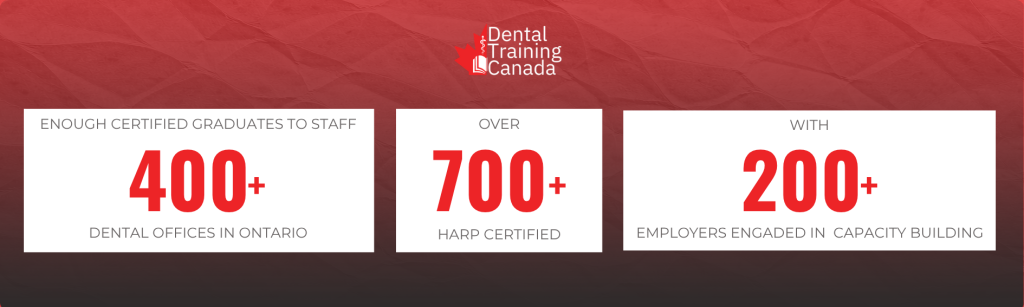
It’s a fact that many Ontario dental offices are understaffed. That much is not new. What has been harder to answer, until now, is exactly how big the gap is, who can fill it, and what it actually takes to train people at scale.
In 2025, Dental Training Canada set out to answer those questions in practice, enrolling multiple cohorts across the year, building an employer partner network from the ground up, and collecting data on every dimension of what worked and what didn’t.
Ontario’s Dental Workforce Shortage is Worse Than You Imagined
National bodies, such as the Canadian Dental Association (CDA) and the Ontario Dental Association (ODA), have estimated a shortage of nearly 5,000 dental assistants across Canada. However, as grim as the numbers appear, they do not begin to scratch the surface of the real problem. With the CDA expecting the shortage to grow year over year for the coming decade, the reality becomes a lot more jarring.
But the headline number understates the structural problem. Between 2010 and 2020, the ratio of newly certified dental assistants to newly entering dentists fell from 3:1 to 1:1. Even before the pandemic, 36% of Ontario dental offices reported unfilled dental assistant positions. The pandemic accelerated what was already a slow-motion crisis.
For Ontario specifically, the bottleneck is not only about numbers, but also about credentials. Every dental assistant performing intra-oral duties in the province must hold both NDAEB certification and a HARP (Healing Arts Radiation Protection) certificate. The HARP certificate is a separate, Ontario-specific provincial requirement (with no national equivalent) that qualifies dental assistants to operate dental radiography equipment. And until recently, access to HARP-approved training programs was limited, expensive, and inaccessible to many of the candidates best positioned to fill the gap, including internationally trained dental professionals who are already living and working in Ontario.
What We Set Out to Do in 2025, And Why
In the years before, we had studied the Canadian dental sector, especially the Ontario landscape, and had understood the major challenges facing the industry. We also understood the need for innovative and strategic ways to bridge the gap between access to care and the scarcity of trained professionals to deliver such care. This encouraged us to plug into the heart of the problem, taking on the challenge to minimize the stressful demand on the current dental assisting workforce while raising a competent, patient-centered, skilled, and ready-to-work army of new dental assistants to fill open roles.
Our target became the two classes of people rightly positioned to do the job:
- Internationally trained dental professionals (ITDs) already in Ontario but unable to work in their field without Canadian credentials, and
- Job seekers from within and outside the dental industry looking for a meaningful way to advance their careers in an accessible way.
Feeding this pipeline became even more important because of the back-breaking pressure on the existing dental workforce due to the Canadian Dental Care Plan. The federal plan extends dental coverage to Canadians without benefits and those with household incomes under $90,000. The CDA estimates the CDCP will require at least an additional 2,300 dental assistants and 1,500 dental hygienists nationally just to absorb new patient volume.
The DTC 2025 Impact Scorecard: What the Data Shows
Enrolment and Training Volume
We met our training bandwidth for the year in 4 months while also building a waitlist of over 1,000 interests who applied before registrations closed. The waitlist was not just a modest overflow but a direct, quantifiable evidence that demand for this training significantly exceeds what a single program year can absorb.
Who enrolled: The 2025 Application Stream Composition
The 2025 intake cohorts can be broken down into three distinct intake groups, each representing a different dimension of Ontario’s dental workforce challenge:
- Internationally Trained Dentists (ITDs)
- Incumbent dental office staff
- Job seekers or career changers looking to secure long-term, AI-proof, and fulfilling jobs in the dental field.
The ITD enrollment numbers are particularly significant in the Ontario context, especially because these are trained dentists, dental surgeons, dental assistants, or oral health specialists, often bringing several years of experience in their countries of origin, looking to overcome the credentialing obstacle between them and obtaining Canadian chairside experience. For these intakes, this is the first professional foothold into practicing dentistry in Canada and helping to fill the expected job openings owing to retirement (42%) and employment growth (43%).
“I had a great experience with Dental Training Canada! The modules were done asynchronously, at your own pace, within 6 weeks. Instructors checked in with us regularly, making it feel like a synchronous course. Enough resources were given to ensure you succeed, including a text book and online modules. I found the textbook incredibly helpful. The practical session was definitely a highlight! You are shown exactly what to do and have enough time to practise before the exam. Thank you for this experience!” –HARP-certified graduate | Incumbent Dental Office Staff, Cohort 8, 2025
“I am very grateful for the opportunity to participate in the government-funded HARP training program. This well-organised training is an outstanding pathway for skilled newcomers facing financial or logistical barriers to obtaining HARP certification. A valuable, well-structured program that delivers real career outcomes.” – HARP-certified graduate | Internationally Trained Dentist, Cohort 5, 2025
The Bigger Picture: What Ontario’s Dental Training System Still Needs
One training program, however well-executed, cannot resolve a structural workforce shortage on its own. What the 2025 HARP certification data makes clear is that the problem is multi-layered and solutions that address only one layer will continue to fall short.
We need to put the big picture into context, step back from it, and break it down into work packages that holistically contribute positively to all pillar areas.
Uneven access to HARP certification
HARP certification and training isn’t evenly accessible across Ontario. Despite increasing pressure on the existing dental workforce, the pipeline, especially in rural and sub-urban Ontario, have limited access to quality training and certification that position them to fill open roles and contribute to the quality of care available to Ontarians.
Addressing this training and certification problem, especially outside of the GTA can help close the skilled dental assistant gap, improve employability, reduce lost revenue due to lack of skilled and competent staff, and overall increase quality of care available to Ontarians.
Are you a dental office in rural or suburban Ontario interested in bringing HARP certification to your town? Click Here.
Employer readiness is a policy problem, not just a training problem
The gap between certified candidates and filled positions will not close through more training alone. It requires investment in employer capacity, industry-specific HR support for small dental practices, structured onboarding frameworks, and employer-facing incentives that reduce the friction between certification and employment.
Dental Training Canada is one organisation working on one piece of this bigger issue. We are publishing this report because the data belongs to a broader conversation and because the Ontario dental industry, its regulatory bodies, its employer community, and other stakeholders deserve an honest account of what one year in the trenches of this problem actually looked like.
If you’ve read this and want to act:
Join our mailing list
Get the latest dental training and industry updates!